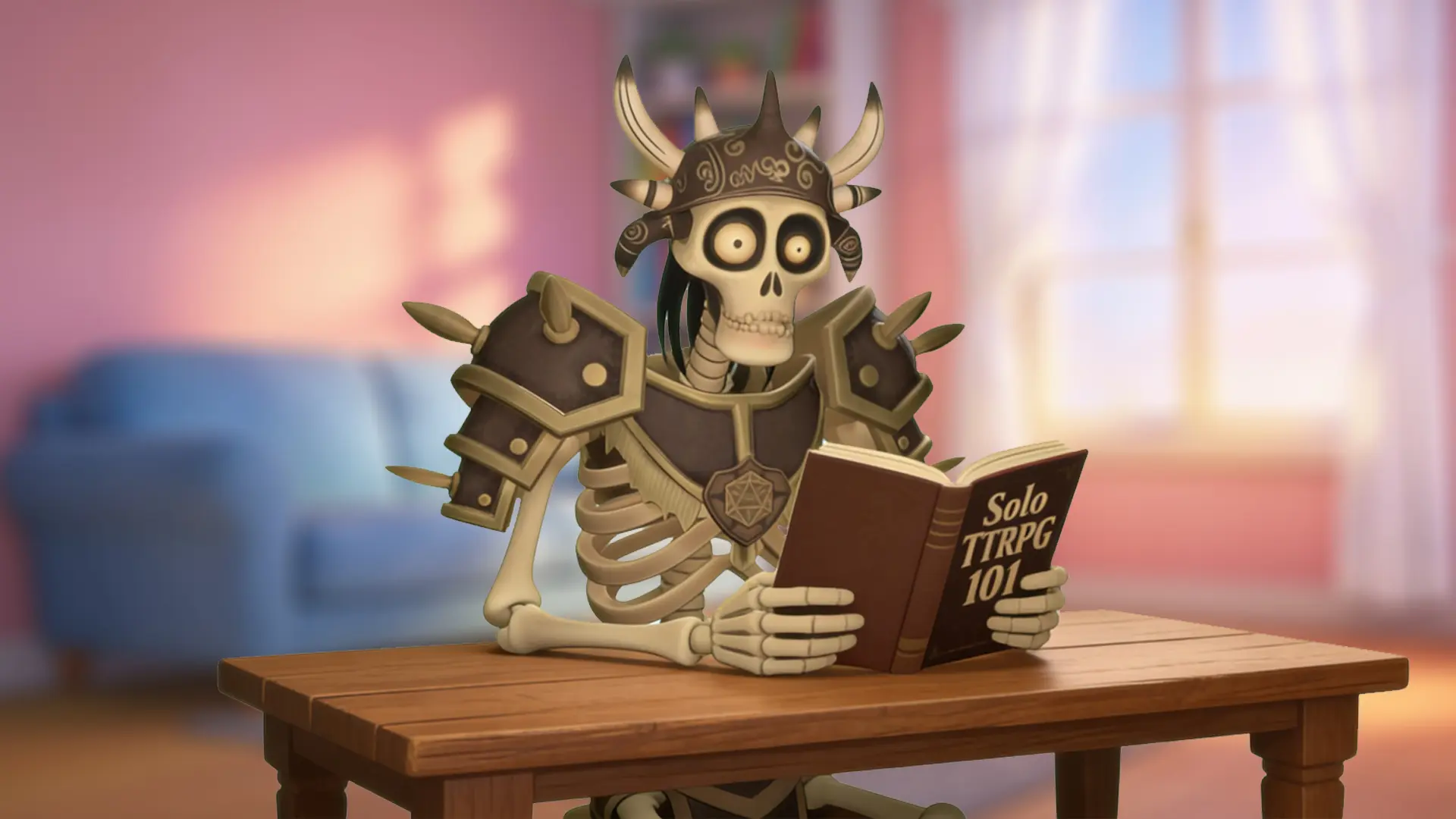
Solo D&D and Tabletop RPGs: The Complete 2026 Guide
Yes, you can play D&D and other tabletop RPGs solo, and 2026 is the best year yet to start. Solo D&D replaces the group and the Dungeon Master with one of six tools: an oracle (like Mythic GME or One Page Solo Engine), a dedicated solo RPG (like Ironsworn), a solo designed module (like DM Yourself or Dragon Delves), a general purpose chatbot used carefully as a co-player, an AI Game Master platform built around 5e, or a tabletop RPG built end to end for an AI Game Master (DungeonsDeep.ai). Wizards of the Coast added official solo guidelines to the 2024 D&D Player's Handbook, so this is no longer a fringe format.
Key Takeaways
- Solo D&D is officially supported. The 2024 Player's Handbook ships with one player rules, and Dragon Delves includes solo adventures.
- There are six methods worth knowing. Oracles, dedicated solo RPGs, solo designed modules, general purpose chatbots, AI Game Master platforms for 5e, and AI native tabletop RPGs like DungeonsDeep.ai.
- The fastest start is an AI Game Master built for solo play. Under ten minutes from sign up to first scene. The deepest analog experience is Mythic GME paired with any system.
- Chatbots are not Game Masters. ChatGPT, Claude, and Gemini forget your campaign, drift on rules, and narrate in your favor. Use them as a flavor and dialogue layer alongside an oracle, not as the GM.
- Solo sessions can be ten minutes. One of solo play's biggest strengths is that it fits between meetings, not between calendars.
Can You Really Play D&D Alone?
Yes. Solo D&D and solo tabletop RPG play replaces the group and the Game Master with a tool that generates the world's response to your character. That tool can be an oracle, a dedicated solo RPG system, a solo designed module, an AI Game Master platform, or a tabletop game built end to end for an AI GM. Sessions can run ten minutes or four hours. You can pause mid scene and resume any time. The 2024 D&D Player's Handbook formalized this with official one player guidelines, and the r/Solo_Roleplaying community has grown into a thriving hub for solo journals, oracles, dice, and stories.
This is the complete guide to playing fantasy tabletop RPGs solo in 2026. It covers every method worth knowing, the real tradeoffs between them, what real solo veterans on Reddit say works, and how to pick the path that fits how you want to play. We are DungeonsDeep.ai, a brand new tabletop RPG of our own, designed end to end for an AI Game Master. We have a horse in this race, and we will be honest about where we fit in this landscape and where we do not.
Before any of that, here is one redditor on r/Solo_Roleplaying on what solo play actually feels like:
"The immersion is just boundless. I can get completely in my head. It's like being a child again, i am 51 now, playing with my action figures in the yard."
If that resonates, you are in the right place.
Solo Tabletop RPGs Are Their Own Format
The biggest mistake new solo players make is treating solo tabletop as a worse version of group play. It is not. Solo RPG and solo D&D are a different format with different strengths, and the people who stick with it tend to lean into what solo does better, not what it cannot do.
One of the best framings we found, from a thread on r/Solo_Roleplaying:
"In group games, I provide the structure while my players bring the chaos. In solo play, I am the structure, so I need the game to bring the chaos and surprises."
That single sentence explains why solo tabletop is built around oracles, dice, random tables, and AI Game Masters. The whole format is about handing structured chaos to yourself so the story surprises you. And it does. Another redditor said it cleaner than anything we could write:
"Personally I find I'm more surprised when playing solo than I ever was playing with groups. Too many GMs telegraph their big reveal."
Why People Play Solo D&D and Tabletop RPGs
The Reddit threads we read for this post lit up with the same handful of reasons over and over. Pull any active thread on r/Solo_Roleplaying and you will see them.
- Scheduling and finding a group. Adult life beats group D&D and tabletop RPGs into a corner, and many players who want to play simply cannot find a table. From a returning player in their 40s on r/rpg: "I love playing, but I hate being the DM. Because of that, I can't even remember the last time I played." Returning players in their 40s who cannot find a group are a huge part of the solo community.
- Total creative control. Another regular on r/Solo_Roleplaying: "I love solo play precisely for the freedom. I'm a hermit. I did group D&D in my 20s, but now in my 40s, I'm done with the social aspects of being human and deeply into having fun by myself." Solo is not a consolation prize for these players. It is the preference.
- Energy on your terms. A group session is a four hour commitment. A solo session can be ten minutes on a Tuesday night when you are wiped from work.
- Self care. One pattern that surprised us across multiple threads: solo RPG as a mental health practice. Players describe it as better than meditation, a way to journal through hard times, and a way to reconnect with parts of themselves they had lost.
- Discovery by accident. Many players stumble into solo RPGs through journaling, creative writing, or shopping for a relative's gift, never having searched for solo D&D and tabletop RPGs at all.
Age range, by the way, skews older than you might think. From a recent reflection thread: "As a person starting their first solo game as part of their new year resolutions to enjoy his life more at 61, a Happy New Year to you too!!" Solo tabletop is not a kids on Discord crowd. It is deeply intergenerational.
A Quick Note on DungeonsDeep Before the Methods
Before we cover every method, here is the honest version of where DungeonsDeep fits.
DungeonsDeep.ai is its own tabletop RPG. The Dungeons Deep Ruleset, an original game system, compatible with fifth edition. Our own world, our own mechanics, designed from day one to be run by an AI Game Master and played solo or in small groups. Adventures written by humans. Run by Artificial Intelligence. A new tabletop game whose ruleset, dice, combat, and narrative flow were designed end to end for solo and small group play with a real AI GM.
The rest of this guide covers every method worth considering, with honest tradeoffs and real quotes from players who have tried each.
How to Play Solo D&D: The Six Methods
1. Oracle Systems (the Analog Default)
Oracle systems are the analog default of the solo RPG world. You ask the oracle a yes or no question ("Is the door locked?" "Does the guard recognize me?"), roll against odds you set based on likelihood, and the oracle answers. Over time, answers stack into a story you did not plan.
The two most cited solo RPG oracles in the community:
- Mythic Game Master Emulator (Second Edition). The deeper option. Tracks scene chaos, throws random events, generates plot twists you would not see coming. Many solo players consider it the single most important book in the format.
- One Page Solo Engine. Free, and exactly what the name says: a single page you can print and use with any system, including the Dungeons Deep Ruleset, D&D 5e, or any homebrew.
Why people love them: the surprises are real. One player described a Mythic GME session: "I was fleshing out this random old guy on the subway. Mythic rolls eventually turned him into a fully fleshed out character and now he's pretty much this adventure's final boss."
- Best for: Players who love the craft of solo RPG play and want to stay close to the dice.
- Time to first session: 30 to 60 minutes of reading, then fast forever.
- Tradeoff: You are still doing most of the narrative work. The oracle gives you surprises, not prose.
2. Dedicated Solo RPGs (Ironsworn and Beyond)
If you are open to leaving D&D 5e behind, the solo RPG world has some of the best designed games in the hobby. These were built from the ground up for one player, and they show it.
- Ironsworn and its science fiction sibling Starforged. The default community recommendation, sometimes called "the D&D 5e of the solo community". Free core rulebook, built in oracle, narrative momentum.
- Four Against Darkness. Procedural dungeon crawler. Run a party of four through randomly generated dungeons. Fast, dice focused, a great beer and pretzels solo game.
- Thousand Year Old Vampire. Solo journaling RPG using prompts to guide you through centuries of a vampire's life. Atmospheric and emotionally heavy.
- Koriko: A Magical Year. Cozy solo RPG about a young witch finding her place in a community. Not every solo game is dungeons and combat.
- Mork Borg, Scarlet Heroes, Ker Nethalas, 2d6 Dungeon, d100 Dungeon. The community is actively diversifying its recommendations beyond Ironsworn. Worth exploring if you want crunch, journaling, or pure dungeon procedure.
One useful Reddit caveat from that same Ironsworn thread: "Ironsworn is more for people for whom rules and strategic combat are less important." If you want crunch, Ironsworn is not your answer. Reach for Scarlet Heroes or Four Against Darkness instead.
- Best for: Players who want the best pure solo RPG experience and are not locked into 5e.
- Time to first session: 30 minutes to 2 hours depending on system.
- Tradeoff: You are learning a new system and leaving D&D 5e behind.
3. Solo Designed Modules and Solo D&D Campaigns
Some adventures are written specifically for solo D&D play, with branching paths and built in GM decisions. Other tools take any existing 5e module and adapt it for solo.
- Tom Scutt's DM Yourself. Adapts existing 5e adventures (Lost Mine of Phandelver, Dragon of Icespire Peak) into a solo D&D experience.
- Wizards of the Coast's Dragon Delves anthology, which includes one player adventures tuned for the 2024 ruleset.
- Paul Bimler's Solo Adventurer's Toolbox. Tables and procedures for turning any 5e content into solo material.
- Free solo D&D campaigns on DriveThruRPG and Reddit. The r/Solo_Roleplaying and r/DnDBehindTheScreen communities maintain growing lists of free solo modules.
- Best for: Players who already own 5e books and want to play specific official adventures alone.
- Time to first session: 1 to 2 hours of setup.
- Tradeoff: You are bound to the module's scope. No improvising into new territory.
4. General Purpose Chatbots (and the DIY AI GM Trap)
This is the rabbit hole that has eaten the most player time and produced the most disappointment. A growing number of solo players try to roll their own AI Game Master by pasting a long prompt into ChatGPT, Claude, or Gemini, handing it a character sheet, and hoping the model holds the campaign together. It almost never does, and the Reddit threads are full of players walking away frustrated.
From the definitive oracle vs AI thread, one redditor:
"AI games don't even work, really. It has the memory of a goldfish. It will make massive context errors, take out of character actions all the time, suddenly forgets everything about a character that just spoke for 20 prompts."
Another, in the same era of threads, on the cognitive cost of using a chatbot as GM:
"AI is way more distracting. I have to explain to AI the contexts and then deal with it forgetting details, or hallucinating things that do not belong to my game. It's like having a multiplayer session with a small kid."
And one redditor's now well known story of a chatbot ignoring its own clue:
"I was tasked with finding a merchant who had stolen something. I get told that the wooden trinkets he sells have intricate carvings in a distinctive style. I go to the market, look at the trinkets and... nothing. Absolutely nothing. The AI just moved on."
The most upvoted r/rpg thread on the topic takes a harder line. Its top voted reply, with 531 points: "Creativity is a skill worth protecting. Outsourcing one's creativity is not something I feel passionate about AI taking over." That concern is real, and it is worth sitting with before you dive in.
The community consensus, after years of trying: chatbots are not a GM, they are a player. Another comment in that same thread put it cleanest:
"Replacing oracles isn't the way. Storyteller AIs are absolutely perfect to complement oracle systems and aid your creativity. They are terrible at steering the plot in a coherent way, something oracles are traditionally good at."
If you want to use a general purpose chatbot, use it as a flavor generator alongside an oracle, not as the GM itself. As a GM, every chatbot we have tested, and every chatbot the solo community has tested, eventually breaks.
- Best for: Generating NPC names, scene flavor, and one shot improvisations alongside an oracle.
- Time to first session: 10 minutes writing a prompt.
- Tradeoff: Memory loss, weak rules adherence, biased dice, and a real risk of creativity atrophy.
5. AI Game Master Platforms Built Around 5e
There is a growing category of platforms that put an AI Game Master on top of D&D 5e or a 5e adjacent ruleset. They narrate scenes, voice NPCs, attempt rule adjudication, and try to hold campaign state. The space is busy and getting busier, and the category is improving fast.
The common challenge across all of them is that 5e was not written for an AI GM, so the AI ends up translating someone else's tabletop ruleset instead of running its own. Rule drift, memory loss, and platform reliability are the issues that come up most often in user reviews and community threads. If you want a 5e shaped experience and are willing to tolerate rough edges while the space matures, this category is worth exploring.
If you want a tabletop game whose ruleset and AI Game Master were built for each other from day one, that is the next section.
- Best for: Players who specifically want a 5e shaped experience and are willing to tolerate rough edges.
- Time to first session: Under ten minutes for most platforms.
- Tradeoff: Rule drift, memory loss, and platform reliability are ongoing issues across the category.
6. A Tabletop RPG Built for an AI Game Master (DungeonsDeep)
This is the bucket DungeonsDeep sits in on its own. the Dungeons Deep Ruleset, an original game system, compatible with fifth edition. Adventures written by humans. Run by Artificial Intelligence. We built our game and our AI Game Master together, so there is no translation layer. Memory is persistent. Dice are fair. Combat is real. Onboarding is under ten minutes. The goblin lieutenant's head you mounted above the tavern fireplace three sessions ago is still there when you log back in.
We built it because the same complaints kept showing up across the solo community, and we wanted to fix them at the foundation rather than paper over them. From our beta recap, one tester:
"Great job remembering the nuances of things we've done in past campaigns. We'd mounted the head of a goblin lieutenant above the fireplace in a tavern. When we returned in a new session, the GM specifically called it out."
That is the bar. We are continuing to raise it.
- Best for: Players who want to start tonight with zero prep and play a tabletop game built for solo and small group play with an AI Game Master from day one.
- Time to first session: Under ten minutes.
- Tradeoff: This is DungeonsDeep, not D&D 5e. If you want to run an official 5e module, one of the other methods will fit better.
Best Solo RPGs and Solo Tabletop Games at a Glance
If you want a fast shortlist of the best solo RPGs and solo tabletop games people actually recommend in 2026, here it is. None of these are wrong choices. Pick by mood.
- Best solo RPG overall: Ironsworn. Free, built in oracle, narrative momentum.
- Best for staying in D&D 5e: DM Yourself paired with an official 5e module.
- Best AI Game Master tabletop RPG: DungeonsDeep.ai, a tabletop game built from scratch for solo and small group play with a real AI GM.
- Best solo dungeon crawler: Four Against Darkness or Scarlet Heroes.
- Best solo journaling RPG: Thousand Year Old Vampire, or Alone Among the Stars for a shorter sitting.
- Best universal oracle: Mythic Game Master Emulator (Second Edition).
- Best free oracle: One Page Solo Engine.
- Best cozy solo RPG: Koriko: A Magical Year.
Solo D&D Online and on Your Phone
You do not need a kitchen table to play solo D&D anymore. The two most common ways to play solo D&D online or on a phone in 2026:
- An AI Game Master platform. Sign up, roll a character, start an adventure. DungeonsDeep.ai runs in any browser, remembers your campaign across sessions, and rolls fair dice on a real backend. A few competing 5e flavored AI GM platforms exist as well; the rough edges across the category are covered in the methods section above.
- A paper oracle plus a notes app. Plenty of solo veterans run Ironsworn or Mythic GME entirely in Obsidian, Notion, or even the iOS Notes app. The phone becomes the journal, the oracle stays on the page.
If you want to play solo D&D on your phone without juggling rulebooks, an AI Game Master built for solo play is the lowest friction option in the category.
Tips From Solo RPG Veterans
The advice in this section is not ours. It is what kept showing up across hundreds of upvoted comments from solo players with years on the table.
- Start before you feel ready. From a beginner advice thread: "You don't necessarily need to read the entire book beforehand, especially if it's a big one. Think of it like a cookbook." Open the rulebook to chapter one and start. Skim the rest as you need it.
- Steal mechanics into a binder. From the classic "there are no rules in solo" thread: "If I like the way D&D handles a short rest, I steal it and add it to 'my rules.' If I want to roll under stats for ability checks, I'll borrow that mechanic from the Black Hack." Solo lets you cherry pick.
- Ask the oracle more questions, not fewer. A counterintuitive tip from another thread on r/Solo_Roleplaying: "There's a lot of people who tell you to keep to a minimum when asking questions of your oracle. But asking questions, good questions, is part of doing exactly that." When stuck, roll for it.
- Give yourself permission to use plot armor. From a six year, 200 plus session solo campaign AMA: "I give my main character plot armor. My party members have a slight amount of plot armor, but they have died in the past. I don't have any specific rules, I just go with what feels good."
- "Do whatever" is the worst advice. From the same "there are no rules" thread: "If you tell me 'do whatever' I'll panic and never touch the game ever again. But if you tell me how you do it, I'll have a baseline from which I can build my own way of playing." Pick a method, copy someone, adjust later.
- Set scene goals, not session goals. "Get through this encounter" beats "finish the dungeon." Solo sessions are shorter and more interruptible than group ones. Lean in.
- Let the dice surprise you. The single biggest mistake solo players make is overriding the oracle when they do not like the answer. The answer is the game.
Which Solo RPG Method Is Right for You?
A short decision rubric for picking your first solo D&D or solo RPG setup.
- "I want to play a great tabletop RPG built for solo, tonight, with zero prep." Try DungeonsDeep.ai. It is its own game, its own rules, its own world.
- "I specifically want to play D&D 5e solo." Pair DM Yourself with an official module like Lost Mine of Phandelver, or try one of the AI GM platforms that attempt to run 5e.
- "I love dice and emergent stories." Mythic GME or Ironsworn.
- "I want something contemplative and written." Thousand Year Old Vampire, or Koriko if you want it cozy.
- "I want a procedural dungeon crawl." Four Against Darkness or Scarlet Heroes.
- "I want to use ChatGPT or Claude as part of my solo setup." Pair it with an oracle. Use the AI as a flavor and dialogue generator, not the GM.
Frequently Asked Questions About Solo D&D and Tabletop RPGs
Can you really play D&D and other tabletop RPGs alone?
Yes. Solo tabletop play replaces the group and the Game Master with a tool that generates the world's response to your character. That tool can be an oracle (Mythic GME, One Page Solo Engine), a dedicated solo RPG (Ironsworn, Four Against Darkness), a solo designed module (DM Yourself, Dragon Delves), or an AI Game Master built for the format. The 2024 D&D Player's Handbook includes official solo guidelines.
How do you play D&D if you don't have friends or a group?
You replace the group with a tool. The fastest path is an AI Game Master built for solo play, which runs the world and the NPCs for you in real time. The analog path is a solo RPG like Ironsworn or D&D paired with an oracle like Mythic GME, where dice and tables generate the surprises a group would normally bring. Either approach gives you a real tabletop experience without needing to recruit a table.
Is it possible to play D&D with only one player?
Yes. The 2024 D&D Player's Handbook includes official solo guidelines, and the Dragon Delves anthology includes one player adventures. Wizards of the Coast formally supports one player D&D in the current ruleset. Outside official support, DM Yourself, the Solo Adventurer's Toolbox, and AI Game Master platforms all let one player run a full D&D campaign with no group required.
What is the best way to play tabletop RPGs alone as a beginner?
The fastest start is a tabletop game built for solo play from day one. DungeonsDeep.ai is a tabletop RPG of our own, separate from D&D, designed specifically for an AI Game Master and small group or solo play. Roll a character and start an adventure in under ten minutes. If you want to play 5e specifically, try DM Yourself with an official module. If you want the analog default, start with Ironsworn or Mythic GME paired with any system you already love.
What is the best solo RPG?
Most solo veterans recommend Ironsworn as the best free standing solo RPG. It includes a built in oracle, narrative momentum mechanics, and a free core rulebook. For solo D&D specifically, the most recommended setups are DM Yourself plus an official 5e module, or an AI Game Master platform built for solo play. For pure surprise factor, Mythic GME paired with any system is the long running gold standard.
Can I use ChatGPT, Claude, or Gemini as my Dungeon Master?
You can, briefly. The Reddit consensus after years of trying is that general purpose chatbots forget your campaign after enough back and forth, narrate in your favor on dice rolls, and drift on rules. Use them as a complement to an oracle, not as the GM. Purpose built AI Game Master platforms solve more of these problems with persistent campaign state, real dice, and enforced mechanics.
Is there a solo D&D app I can play on my phone?
The closest thing to a true solo D&D app in 2026 is an AI Game Master platform that runs in a browser on your phone. DungeonsDeep.ai runs in any modern mobile browser, holds persistent campaign memory, and rolls fair dice. Many solo D&D players also use phone notes apps (Obsidian, Notion, iOS Notes) as the journal alongside a paper oracle like Mythic GME or the free One Page Solo Engine.
Are there free solo D&D campaigns I can download?
Yes. The One Page Solo Engine is free and works with any system. Tom Scutt's DM Yourself is paid but converts any 5e adventure you already own. r/Solo_Roleplaying and DriveThruRPG maintain free solo modules and free solo campaigns from independent designers. For a fully free start, pair the One Page Solo Engine with the basic 5e rules from D&D Beyond.
Do I need to buy new books to play solo D&D?
No. If you already own a 5e Player's Handbook and any official adventure, you can play solo with the free One Page Solo Engine or Tom Scutt's DM Yourself. AI Game Master platforms do not require physical books.
How long does a solo tabletop session take?
Anywhere from 10 minutes to several hours. One of solo play's biggest advantages is that you can pause and resume any time. A single encounter can fill a lunch break, or you can settle in for a long evening. There is no group schedule to match.
Is D&D good for people with ADHD?
Solo D&D and solo tabletop RPGs are often described by ADHD players as a better fit than group D&D. You set the pace, you set the session length, and you can stop and resume without coordinating six other calendars. The structured chaos of an oracle gives the brain something to latch onto, and short scene level goals work well with ADHD attention patterns. Group D&D can also be a good fit, but the scheduling and four hour blocks are the most cited friction.
Is solo tabletop just creative writing?
No. The whole point of oracles, dice, and AI GMs is that they generate outcomes you did not plan. The community pushes back hard on the "just write a book" dismissal because solo play uses real game mechanics to surprise you. As one redditor put it: "the whole 'just write a book' is such a BS comment about solo RP."
Ready to Start Your Solo Adventure?
Solo tabletop play is no longer a compromise. It is its own format with its own strengths, and the barrier to your first session has never been lower. Whatever method you pick, the door is open.
If you want the fastest start and a tabletop game built end to end for solo and small group play with an AI Game Master, try DungeonsDeep.ai. The Dungeons Deep Ruleset, an original game system, compatible with fifth edition. Adventures written by humans. Run by Artificial Intelligence. Persistent memory, fair dice, and real enforced rules. Roll a character, light a torch, and see how deep your party is willing to go before something stops them.
Tell us which method you are starting with on Discord or the DungeonsDeepAI subreddit. We read everything.
This work includes material from the System Reference Document 5.2 (“SRD 5.2”) by Wizards of the Coast LLC, available at https://www.dndbeyond.com/srd. The SRD 5.2 is licensed under the Creative Commons Attribution 4.0 International License, available at https://creativecommons.org/licenses/by/4.0/legalcode.